
Olivia Otto · 22 September 2026
Employment Dynamics Following Transit Expansions in Poland's Silesian Industrial Zone
Poland's Upper Silesia region has long served as the country's industrial core, and recent transit investments there have produced measurable shifts in local employment patterns according to government statistical releases. Projects such as the Silesian Interurban Tram upgrades and rail corridor modernizations link former mining towns with emerging logistics and service hubs, while data from the Central Statistical Office of Poland tracks job gains in construction, maintenance, and related sectors through 2025.
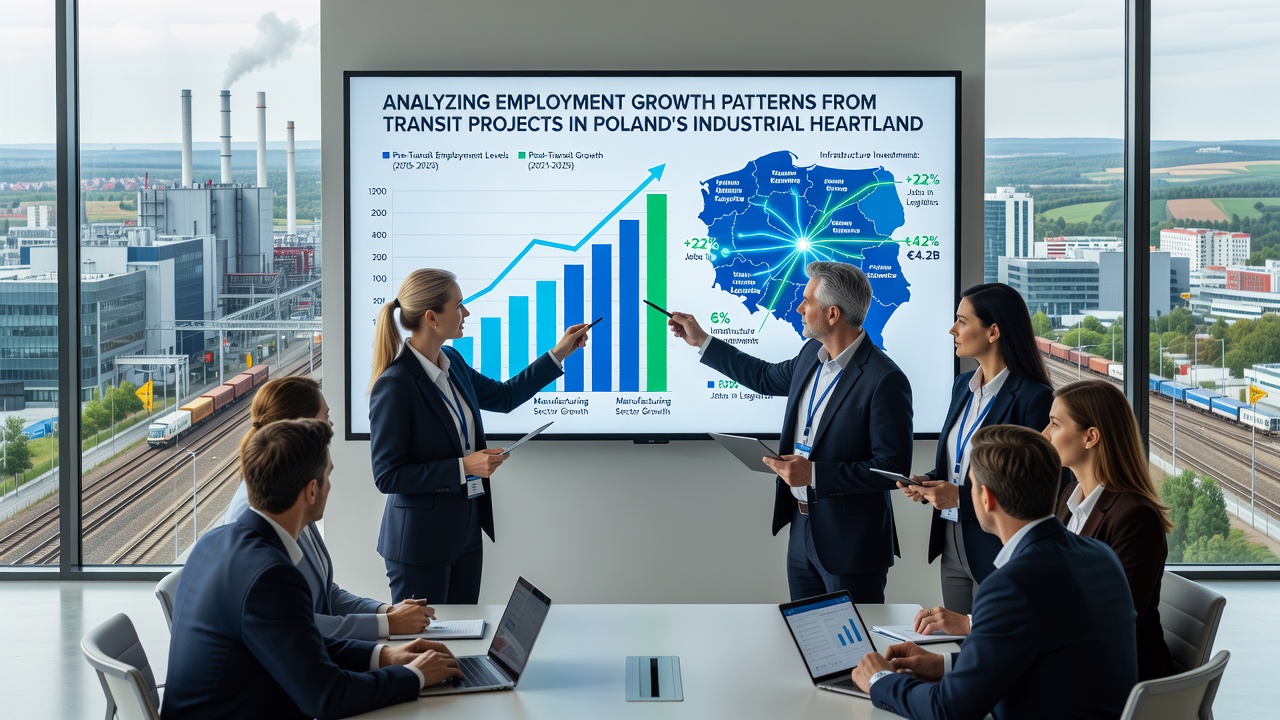
Analysts at regional planning offices note that areas within five kilometers of new transit stations recorded higher rates of employment growth compared with more distant zones between 2022 and 2025, and these patterns align with findings from similar infrastructure programs documented by the European Commission transport directorate. Construction phases alone supported temporary positions that later transitioned into permanent roles in operations and retail near completed stations.
Regional Context and Project Timeline
Upper Silesia encompasses the Katowice conurbation and surrounding coal-dependent municipalities where authorities have prioritized multi-modal transit links since the mid-2010s. In September 2026 several line extensions reach operational status, which observers expect will further influence commuting patterns and business location decisions. Official project reports indicate that integrated ticketing systems and park-and-ride facilities reduce travel times for workers moving between legacy industrial sites and newer distribution centers.
Employment data compiled by the Silesian Voivodeship labor market observatory reveal that sectors tied directly to transit operations, including vehicle maintenance and signaling technology, expanded their workforce by double-digit percentages in the three years preceding the 2026 milestones. Meanwhile, indirect effects appear in hospitality and small-scale manufacturing clusters that benefit from improved passenger flows.
Data Patterns Across Municipalities
Comparative figures from the Polish Ministry of Infrastructure show that municipalities hosting major interchange points experienced faster private-sector job creation than peer localities without equivalent investments. For instance, towns along the modernized Katowice-Gliwice corridor posted net gains in logistics employment, whereas areas still awaiting full connectivity lagged behind. These outcomes mirror trends captured in World Bank urban mobility studies that examined transit corridors in Central European industrial regions.
Longer-term tracking through 2025 also highlights a gradual reallocation of labor from extractive industries toward transport-related services, with training programs funded by EU cohesion funds contributing to the shift. Researchers at the University of Economics in Katowice have mapped these changes using longitudinal employer surveys, confirming that station proximity correlates with higher retention rates for skilled workers who previously commuted longer distances by car.
Broader Economic Linkages
Transit expansions have intersected with regional strategies to diversify the economy beyond coal, and employment statistics reflect this transition. Logistics firms report increased hiring near new freight-rail connections, while technology startups cite improved public transport access as a factor when choosing office locations. Figures released by the Silesian Development Agency indicate that foreign direct investment announcements in the region rose steadily alongside completed transit segments through the first half of 2026.
Commuting data further illustrate the impact: average travel times between residential districts and employment centers declined in corridors served by upgraded lines, enabling workers to access a wider range of job opportunities without relocating. This effect appears consistent with patterns observed in other post-industrial European regions where similar investments occurred.
Measurement Challenges and Ongoing Monitoring
Quantifying precise employment attribution remains complex because multiple economic variables operate simultaneously, yet statistical agencies continue refining methodologies that isolate transit effects. Quarterly labor reports now incorporate geospatial analysis that compares employment densities before and after station openings. Such approaches allow planners to distinguish between general regional recovery and infrastructure-driven gains.
By September 2026 updated datasets covering the newest extensions will become available, providing additional points for longitudinal studies. Authorities have committed to publishing these figures alongside forecasts that model future job distributions under different investment scenarios.
Conclusion
Transit projects in Poland's Silesian industrial heartland have generated documented employment growth patterns that researchers continue to track through official statistics and geospatial methods. As additional segments become operational in September 2026, the data will offer further insight into how connectivity influences labor markets in regions undergoing structural economic change.